
1. Introduction
Is your bank account ready for the new UK visa rules?
If you are planning to join a UK university for the January 2026 or September 2026 intake, you need to update your budget immediately. On November 11, 2025, the UK Home Office officially increased the “maintenance funds” requirement—the minimum amount of money you must show to prove you can support yourself.
For years, students used old figures (like £1,334 for London), but those numbers are now obsolete. Applying with the old figures will result in an automatic visa refusal, costing you your application fee and a permanent mark on your immigration history.
This guide breaks down exactly how much you need to hold in your account for the new 2025/2026 rules, how the exchange rate affects you, and the critical changes to the Graduate Route you must know before you book your flight.
2. The New Financial Numbers (2025 Update)
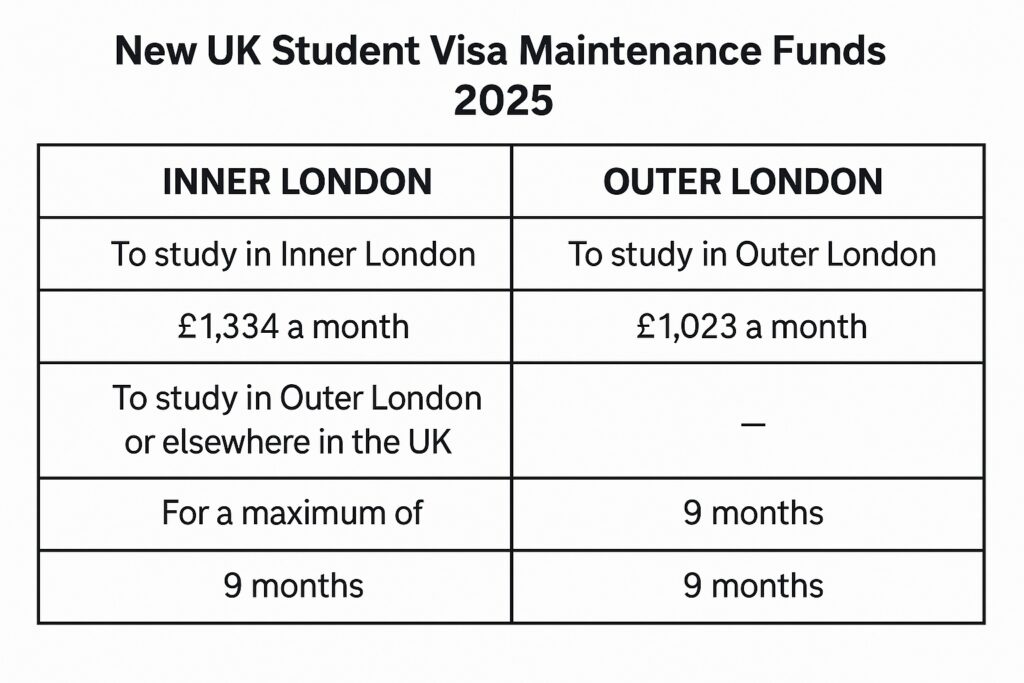
The “maintenance requirement” is the cash you must hold for living costs, in addition to any unpaid tuition fees. The amount depends entirely on where your university is located.
- Inner London: Includes the City of London and the 32 London boroughs.
- Outer London: Everywhere else in the UK (e.g., Manchester, Birmingham, Glasgow, Edinburgh).
New Monthly Maintenance Requirements (Effective Nov 11, 2025)
| Location of University | Old Requirement (Monthly) | NEW 2025 Requirement (Monthly) | Total Lump Sum (For 9 Months) |
| Inside London | £1,334 | £1,529 | £13,761 |
| Outside London | £1,023 | £1,171 | £10,539 |
Key Insight:
If you are studying in London, the requirement has jumped significantly. You now need to show a total of £13,761 (approx. $17,500 USD) just for living expenses. This does not include your tuition.
The “28-Day Rule” Remains Unchanged:
Even with the higher amounts, the strict “28-day rule” applies. You must hold this exact total (or higher) in your account for 28 consecutive days. If the balance drops below £13,761 for even one day during that period, your bank statement is invalid.
3. Real-World Currency Impact (November 2025 Rates)
The biggest trap for international students is the exchange rate fluctuation. The UK Home Office uses the official spot exchange rate on the date of your application (usually OANDA rates). If your local currency dips against the Pound Sterling (GBP), you could suddenly fall short.
Here is what the New London Requirement (£13,761) looks like in major currencies (estimated rates as of late Nov 2025):
- 🇳🇬 Nigeria (Naira): At ~₦1,916/£, you need approx. ₦26,366,000.(Recommendation: Keep at least ₦28 Million to be safe against volatility).
- 🇮🇳 India (Rupee): At ~₹118/£, you need approx. ₹1,623,800.
- 🇬🇭 Ghana (Cedis): At ~14.7/£, you need approx. GH₵ 202,300.
- 🇵🇰 Pakistan (Rupee): At ~371/£, you need approx. PKR 5,105,300.
> Pro Tip: Never hold the “exact” amount. Always buffer your account by at least 5-10% above the requirement. A small currency crash on the day you submit your application can lead to a rejection for “insufficient funds.”
4. Critical Update: The Graduate Route (Post-Study Work) Visa
While the financial rules are active now, there is a major policy shift looming for the Graduate Route visa (often called the PSW).
- Current Rule: Bachelor’s and Master’s graduates get 2 years to stay and work.
- The 2027 Change: The UK government has confirmed that for students graduating after January 1, 2027, the visa duration will be reduced to 18 months.
What this means for you:
If you start a 1-year Master’s degree in September 2025, you will likely graduate in late 2026. You should still fall under the 2-year rule. However, if you defer or take a longer course that ends in 2027, you may face the shorter 18-month stay. PhD graduates remain unaffected and will still receive 3 years.
Action Plan for You
- Check Your CAS: Does your Confirmation of Acceptance for Studies say “London” or “Outside London”? Don’t guess.
- Contact Your Bank: Ask if they can provide a letter explicitly stating the funds have been held for 28 days.
- Calculate Your Total: (Tuition Remaining) + (Maintenance Funds) = Total Proof Needed.
5. Frequently Asked Questions (FAQ)
Q: Can I use my parent’s bank account to prove funds? A: Yes, UKVI allows this, but you cannot just submit their statement. You must provide three specific documents:
- The original bank statement in their name.
- Your birth certificate (showing their name as your parent).
- A signed letter of consent from them confirming they are sponsoring you and you have access to the funds. Note: You cannot use an uncle, brother, or aunt’s account unless they are your legal court-appointed guardian.
Q: What if I have a partial scholarship? A: You can deduct the scholarship amount from your total financial requirement.
- Example: If you need £10,539 for maintenance and your scholarship provides £5,000 for living costs, you only need to show the remaining £5,539 in your bank account. You must provide an official scholarship award letter as evidence.
Q: Does money invested in stocks, crypto, or mutual funds count? A: No. The UK Home Office strictly requires “liquid cash” that can be withdrawn immediately. Investments, shares, bonds, property, and Bitcoin are not accepted. If your money is in a fixed deposit (FD), you must provide a letter from the bank confirming the funds can be withdrawn at any time.
Q: How much extra money do I need for my spouse (Dependent)? A: If you are bringing a dependent (husband, wife, or child) in 2025, they have their own maintenance requirement.
- London: You need an additional £845 per month (£7,605 total).
- Outside London: You need an additional £680 per month (£6,120 total).
- Warning: These funds must be held in addition to your own funds for the same 28-day period.
Q: Which exchange rate will the Visa Officer use? A: The Home Office uses the OANDA spot exchange rate on the exact date you submit your online application. If your local currency (Naira, Rupee, Cedi) crashes against the Pound on that specific day, you could be refused.
- Recommendation: Always keep a buffer of 5–10% above the required amount to be safe.
Conclusion: Don’t Let Math Ruin Your Study Plans
The jump to £13,761 (London) and £10,539 (Outside London) is significant, but it is manageable with early planning. The most common reason for student visa rejection isn’t a lack of money—it’s technical errors, such as not holding the funds for the full 28 days or using the wrong exchange rate.
Your Checklist for November 2025:
- Verify if your university is classified as “Inner” or “Outer” London.
- Calculate your total liability (Tuition Balance + Maintenance).
- Add a 10% currency buffer.
- Print your bank statement only after the funds have matured for 28 days.
Are you applying for the September 2025 intake? Drop a comment below if you need clarification on calculating your specific proof of funds.
